

Technology and AI Luminary Neal Fishman Publishes Manifesto Calling for Global Licensing and Certification of AI Systems
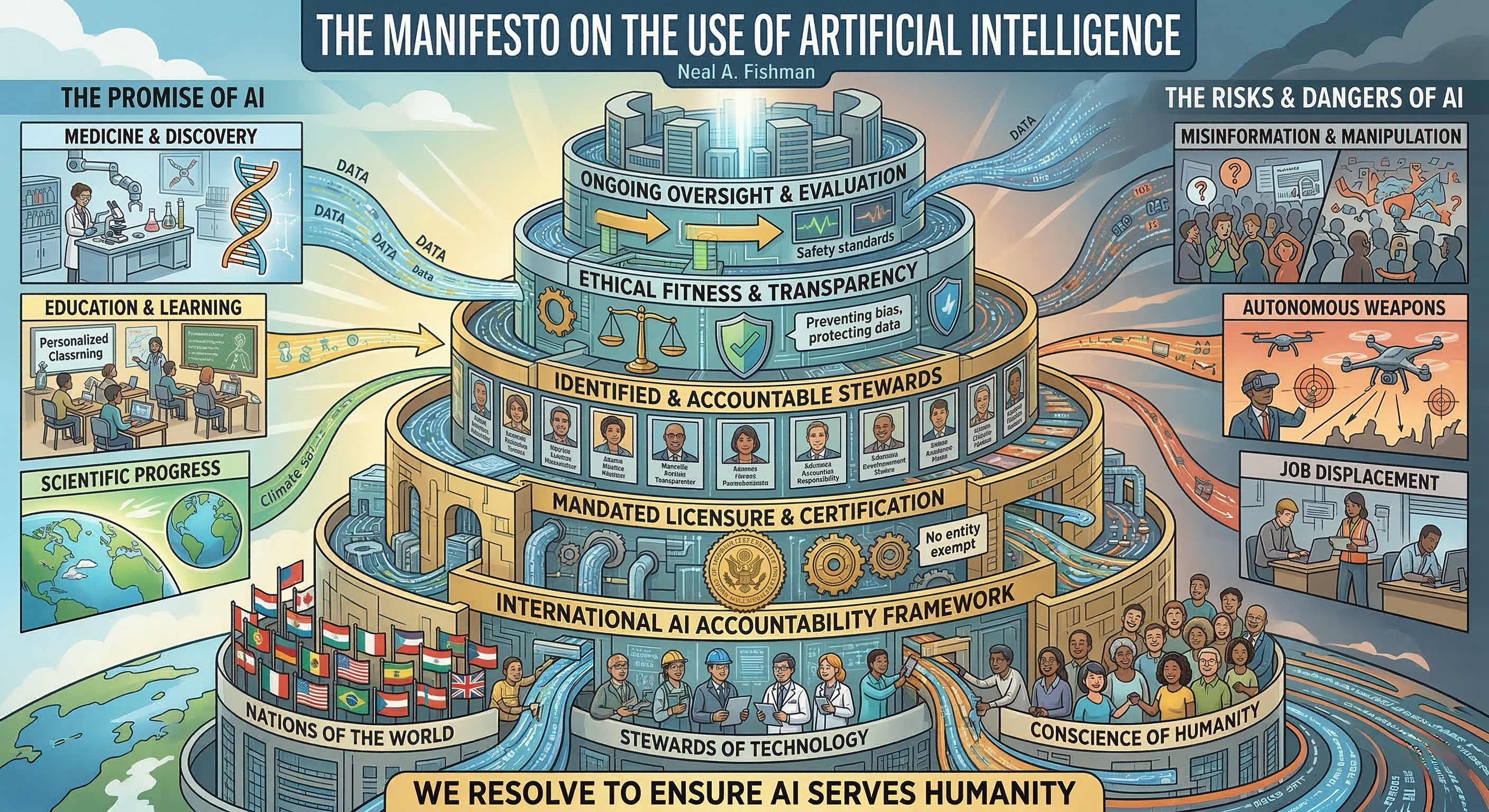
A Worldwide Call To Action
Fishman’s manifesto draws parallels between AI governance and nuclear nonproliferation, urging nations to act before the window for meaningful oversight closes
JERSEY CITY, NJ, UNITED STATES, March 17, 2026 /EINPresswire.com/ -- Neal Fishman, a widely published technology author and recognized authority on artificial intelligence, has published “The Manifesto on the Use of Artificial Intelligence,” a comprehensive call to action urging the nations of the world to adopt a universal framework for the licensing and certification of AI systems. The full text of the manifesto is available now on Medium.
The manifesto argues that the unregulated creation and deployment of AI systems poses a compounding threat to human autonomy, economic stability, democratic governance, and the public’s ability to distinguish truth from fabrication. Fishman contends that these are not speculative harms but present ones, and that all indicators point to an acceleration.
“Unlike a weapon, which must be aimed and fired, an AI system can operate continuously,” Fishman writes. “A single unchecked AI system, deployed at scale, can affect billions within hours by shaping what they see, believe, and what opportunities they are offered or denied. When such systems operate without oversight or any accountable party, the result is not innovation. It is ungoverned power.”
At the core of the manifesto is a foundational principle: that no entity — corporate, governmental, academic, nonprofit, or individual — should be permitted to create, train, deploy, or materially modify an AI system without first obtaining a license from a duly authorized governing body. Fishman frames this not as a radical proposition but as a logical extension of standards society already applies to medicine, aviation, construction, broadcasting, hazardous materials, and nuclear energy.
The manifesto outlines a detailed framework of accountability built on several pillars: mandatory identification and registration of AI systems above a defined capability threshold, demonstration of both technical competence and ethical fitness as a condition of licensure, declaration of purpose and operational boundaries for each system, periodic evaluation and renewal of licenses, and the attachment of personal legal liability to named human decision-makers rather than to corporate entities alone.
Fishman directly addresses the most contested dimensions of the debate. The manifesto calls for a tiered approach to open-source AI development, calibrating obligations to the scale and context of deployment rather than to the act of creation alone. It rejects exemptions for military and national security applications, arguing that excluding the most consequential and most dangerous uses of AI from accountability would fatally undermine the entire framework. And it confronts the geopolitical rivalry between major AI powers head-on, arguing that the depth of competition between nations is not a reason to abandon the pursuit of international governance, but among the strongest arguments for it.
“History teaches us that the most consequential international agreements have not emerged from moments of trust and goodwill,” Fishman writes. “They have emerged from moments of shared danger.”
The manifesto calls for a binding international accord on AI licensure, modeled on the institutional logic of organizations such as the International Atomic Energy Agency and the International Civil Aviation Organization. Fishman acknowledges that such an accord will be imperfect and difficult to achieve, but argues that a flawed framework that constrains the worst outcomes is vastly superior to no framework at all.
Fishman emphasizes that the manifesto is not a document of opposition to AI but one of protection. “Licensing and certification are not the enemies of innovation,” he writes. “They are the conditions under which innovation earns and retains public trust.”
The full manifesto is available at: https://medium.com/p/fca6622a2c6b
About Neal Fishman
Neal Fishman is a retired IBM Distinguished Engineer, Open Group Distinguished Chief Architect, and a Chief Technology Officer with Rehavior. He is a technology expert and author who has published numerous books on technical subjects and artificial intelligence. Over the course of his career, Fishman has established himself as a leading voice on the responsible development and governance of emerging technologies. His work bridges the gap between deep technical understanding and the broader policy, ethical, and societal questions that define the AI era.
Neal Fishman
Rehavior
+1 646-457-0798
neal.fishman@gmail.com
Visit us on social media:
LinkedIn
Legal Disclaimer:
EIN Presswire provides this news content "as is" without warranty of any kind. We do not accept any responsibility or liability for the accuracy, content, images, videos, licenses, completeness, legality, or reliability of the information contained in this article. If you have any complaints or copyright issues related to this article, kindly contact the author above.
